In this week’s post, I want to cover a new musical concept that can help when you’re writing chord progressions. As I have mentioned in previous posts, a chord progression is a series of chords played in a certain order. Chord progressions form the basis of all harmonic development in music, and in my negative harmony post I talked about the importance of avoiding commonly used progressions that are often heard in modern pop music. Modulation is a strategy that can be utilized to construct interesting and effective progressions.
Modulation is the shift from one tonal center to another. A tonal center is just the “home base” note for a given chord progression. For example, in the key of C major, C is the tonal center. By using modulation, a musician can easily shift the tonal center from C to G. After this shift takes place, G would sound like the new “home base”.
In order to pull off this shift, we first need to understand a bit about chords. The simplest chords are called the diatonic chords. Let’s take the key of C major. The C major diatonic chords can be created by just stacking two extra notes on top of the notes in the C major scale.
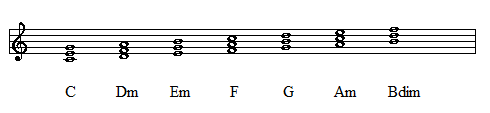
Likewise, the G major diatonic chords can be created by stacking two more notes on top of the notes in the G major scale.
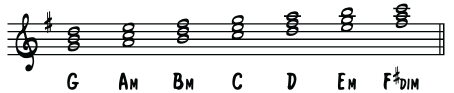
Now let’s look at what chords these two keys have in common. Both keys share the chords C major, E minor, G major, and A minor. In order to modulate from the key of C major to G major, all you have to do is use one of the chords that both keys share. This is known as a “pivot chord”.
To show modulation in an example, I have written a short chord progression. It starts in the key of C major, reaches the pivot chord, and then shifts to the key of G major.
C – F – G – Em – Am (pivot chord) – D – G
Before I start the progression, I play the note C so that you can hear a clear tonal center. After the progression, I play a G to show how the tonal center shifted due to the use of modulation.
In summary, modulation is an nice tool that allows for a fluid transition between keys in a chord progression. It can be used to make an otherwise simple progression much more interesting.
But that’s just a theory. A music theory.
-gwilliams5
 Music Theory Blog