At its core, music is comprised of two essential components: pitch and rhythm. Pitch is the note or group of notes that is being played, while rhythm is the pattern and frequency that these notes are arranged in. Music without one or the other would sound disastrous, as they each play an important role in the structure of a song. But how different are pitch and rhythm from each other?
As it turns out, pitch and rhythm are the same.
Pitch is defined as the number of vibrations per second; our brain perceives a certain note based on how many times per second the air around our ear vibrates. The unit for pitch is Hertz, or vibrations per second.
Rhythm is defined as the number of beats per minute, or BPM.
Therefore, rhythm and pitch are the same; both are a constant vibration/beat that occurs at a given interval. The only difference is that they just occur at much different speeds.
In terms of perception, the human ear can detect pitch from about 40 Hz to 20,000 Hz. As we age or experience ear damage, the upper limits of our hearing capacity can lower, usually down to about 15,000 Hz or less.
Rhythmic perception also has limits. Most people start to lose the sense of rhythm around 600 BPM, or 10 Hz. A rhythm that’s faster than 10 beats per second sounds blurry to the ear.
Given these limits, what happens in between 10 Hz and 40 Hz?
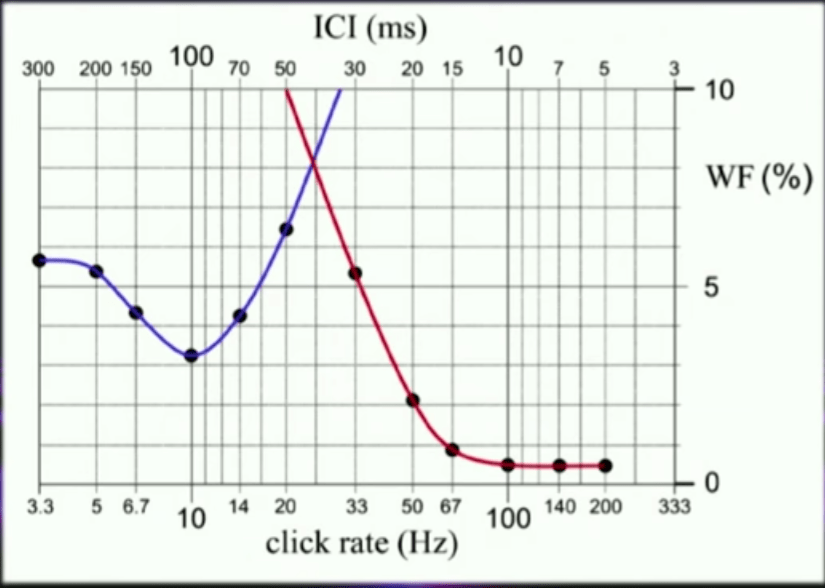
The graph above shows this relationship, with rhythm being the blue line and pitch being the red line. Higher y values on the graph correspond with sounds that are harder to perceive. The following video clip demonstrates the zone where rhythm turns into pitch.
10:16-11:08
Just as a single rhythm can become a pitch, multiple rhythms at once can become multiple pitches at once. If rhythm is the same as pitch, then polyrhythms (multiple simultaneous rhythms) should be the same as “poly-pitches”, or chords (multiple simultaneous pitches).
This proves to be true: All intervals, or spaces between notes, are polyrhythmic. In other words, all of the proportions that make up polyrhythms correspond to the proportions that make up the intervals between notes.
The general rule is that simple proportions correspond with rhythms and pitches that sound resolved, rather than dissonant. For example, the 4:5:6 ratio is a nice sounding, straightforward polyrhythm. This ratio also corresponds with the major chord; the three notes in any given major chord are produced using pitches that have a ratio of 4:5:6 between each other. If a 400 Hz, a 500 Hz, and a 600 Hz pitch are played at the same time, they make a major chord.
24:20-25:20
In turn, complicated polyrhythms sound dissonant when sped up. The 15:8 polyrhythm becomes a major seventh interval (very dissonant) when sped up.
Overall, the relationship between pitch and rhythm is extremely interesting, given how different the two seem at a first glance.
But that’s just a theory. A music theory.
-gwilliams5
 Music Theory Blog