This week, we once again explore the close connection between music and math as we learn a simple method to calculate key signatures.
As you probably already know, there are 12 distinct keys in music; any scale, melody, or song can be played in any of these 12 keys. Changing the key of a song often results in adding accidentals, which are known as sharps and flats (the black keys on a piano). A song in the key of F major has a single flat, Bb, and this is shown by F major’s key signature:
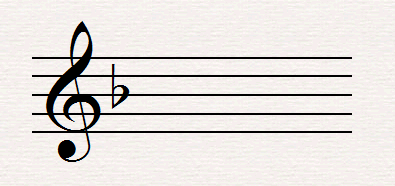
The above key signature is one of the simpler ones; key signatures can have up to seven flats or sharps each. In total, this amounts to 30 different key signatures, if we include minor keys and enharmonic spellings. Most music students are expected to know all 30 in college. Luckily, using the key signature calculation method, there is no reason to memorize all 30, but only 7.
In this method, each key signature is assigned a numerical value, based on the number and type of accidentals. Sharps are positive and flats are negative.
C major, which has zero sharps and zero flats, is 0
G major, which has 1 sharp, is 1.
D major, which has 2 sharps, is 2.
F major, which has 1 flat, is -1.
A is 3, E is 4, and B is 5.
With those seven memorized, it becomes easy to find any of the remaining 23. To go from one of these to it’s flat variant, subtract 7. A is 3, so Ab is -4. This means Ab has 4 flats.
To get to a sharp variant, add 7. F is -1, so F# is 6, meaning F# has 6 sharps.
To get from major to minor, subtract 3. Starting with C major, subtract three to get C minor, resulting in -3. C minor has 3 flats.
The opposite is true if you start with a minor; add three to get the major. D minor has one flat, and -1 + 3 = 2, so D major has 2 sharps.
In summary, the key signature calculation method is a simple way to figure out tricky key signatures, without having to rely strictly on memory.
But that’s just a theory. A music theory.
-gwilliams5
 Music Theory Blog