Irrational time signatures are best explained if we first understand their rational counterparts. In music, time signatures are rhythmic devices that tell us the number of counts in each measure, and the value of each of these counts. Let’s take a simple form of a rational time signature:

Both numbers tell us different things. The denominator, 4 in this case, always refers to the value of each count. Specifically, it refers to how many times a whole note has been divided up; in 3/4 time, the whole note has been divided into 4 pieces. This is why notes in (any #)/4 time are called quarter notes. The numerator simply tells us how many of these notes exist in a given measure, which is 3 in this case. In short, 3/4 time just means that one measure contains 3 quarter notes.
In fact, any time signature that follows the pattern 1/2, 1/4, 1/8, 1/16, 1/32, etc. is considered to be rational. If you imagine a pie, any of these divisions would be easy to do, as you simply halve each slice of pie to continue the pattern. Irrational time signatures are where things get trickier. Any time signature that doesn’t follow the above pattern is considered to be irrational. For example, 3/7 time would mean that there are 3 “seventh” notes in each measure. Going with the pie analogy, imagine trying to cut one into seven equal slices; much more difficult.
So when do composers even use irrational time signatures? They actually have very specific applications. Creating an entire piece in the time signature of 4/6 would be unnecessarily confusing. There would be no reason to do this because a composer could just as easily write the piece in 4/4 and it would sound exactly the same (there would still be 4 equally-spaced counts per measure). Irrational time signatures are only useful when used in conjunction with rational time signatures.
For example, let’s say I want four quarter notes, followed by four quarter note triplets, followed by four more quarter notes. There are many ways to write this. One way is to say that all of the measures are in 4/4, and to write out the rhythms normally. This is called standard notation:

While it is what I want to write, it looks more complicated than it should. The spacing between the first four notes is exactly the same as the spacing between the last four notes, but they look completely different.
Another way to write this would be to literally change the tempo halfway through the phrase by using metric modulation. Here’s what that would look like:
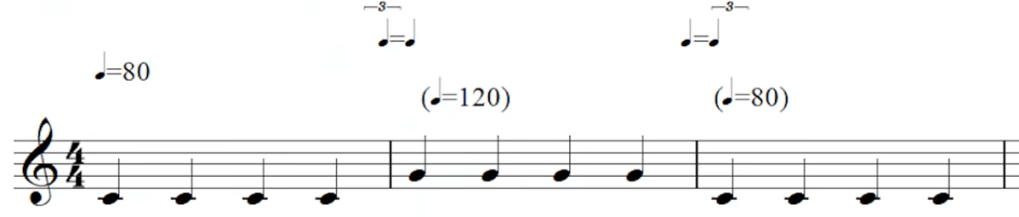
Again, things seem more complicated than they should. Musicians tend to avoid sudden tempo changes. Finally, here is what the phrase would look like with the use of an irrational time signature:

By switching between 4/4 and 4/6, I can clearly convey the intended rhythm without using the bulky format that both standard notation and metric modulation require.
Irrational time signatures can be used to effectively write complicated rhythms. In many cases, they serve to be more straightforward than other rhythmic notations. To avoid confusion, it is important to only use irrational time signatures in conjunction with rational ones, because without context, irrational times signatures are unnecessary.
But that’s just a theory. A music theory.
-gwilliams5
 Music Theory Blog