A polyrhythm is defined as the mathematical relationship between two or more simultaneous events. In music, a simpler explanation of a polyrhythm is when two separate but constant rhythms play at the same time, and line up together according to a specific ratio.
For example, one of the most common polyrhythms is two against three. The ratio, 2:3, means that two evenly spaced pulses play in the same amount of time as three evenly spaced pulses. At the start of every cycle, both pulses play together, and then continue to loop based on the ratio between them. Here’s an example of this polyrhythm played on bongos:
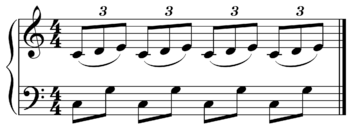
I play the “3” part of the polyrhythm on the higher-pitched drum, and the “2” part of the polyrhythm on the lower-pitched drum. You can hear that both drums start at the same time, and then line back up when the cycle restarts. If you isolate either of the two drums, you can hear that all of the hits are evenly spaced, so the tempo of any given drum is constant.
Another common polyrhythm is three against four. In 3:4, three evenly spaced pulses play in the same amount of time as four evenly spaced pulses:
Finally, here’s what four against five, or 4:5, sounds like:
Once again, if you isolate one of the two drums, you hear that the pulse is constant, despite the complexity of the composite rhythm, which is another name for the combination of two rhythms.
Polyrhythms start to sound more dissonant as the complexity of the ratio increases. For example, it is extremely difficult to hear the pulse in fifteen against eight, or 15:8. For this reason, the applications of polyrhythms in actual music are limited. However, a few genres do make regular use of simpler polyrhythms, such as 2:3 and 3:4, which can be found in sub-Saharan African and Afro-Cuban music.
One of my favorite uses of the 3:4 polyrhythm is from The Legend of Zelda: Breath of the Wild. “Great Fairy Fountain” is an arrangement made for solo piano, and effectively uses the 3:4 polyrhythm to create an interesting rhythmic effect. The right hand plays the melody using the “4” part of the polyrhythm while the left hand harmonizes while using the “3” part of the polyrhythm:
“Great Fairy Fountain” plays 3:4 much faster than my bongo example, so it can be difficult to hear the polyrhythm at first. Despite this, the result is a subtle yet stylistically effective composite rhythm.
Overall, polyrhythms are interesting rhythmic patterns that can sound unique when played by themselves. Some musical compositions utilize simple polyrhythms for a distinct rhythmic effect.
 Music Theory Blog
