To explain exactly what negative harmony is, I first need to clarify some basic musical concepts. In every major scale, there are two kinds of notes: stable notes and active notes. Let’s take the notes from the C major scale:
C – D – E – F – G – A – B – C
The stable notes are bolded: C, E, and G. These three notes make up the C major chord. Stable notes sound just as the name implies; they don’t want to move. The active notes are thus all of the other notes: D, F, A, and B. Active notes lean towards the stable notes, which creates tension; they want to resolve. This concept of tension and resolution forms the basis for all musical chord progressions, or groups of notes that sound good together when played in a certain order.
Here’s an example of a basic chord progression:
C major – A minor – F major – G major – C major
While it sounds good, it’s not very interesting. There are definitely moments of tension and release, but to me, this chord progression is a little too simple. This is where negative harmony comes into play. Musicians can utilize negative harmony to make simple chord progressions much more creative.
Negative harmony is made by writing out all of the twelve notes in a circle and drawing an axis across the middle. Each note is then paired with its corresponding note across the axis:
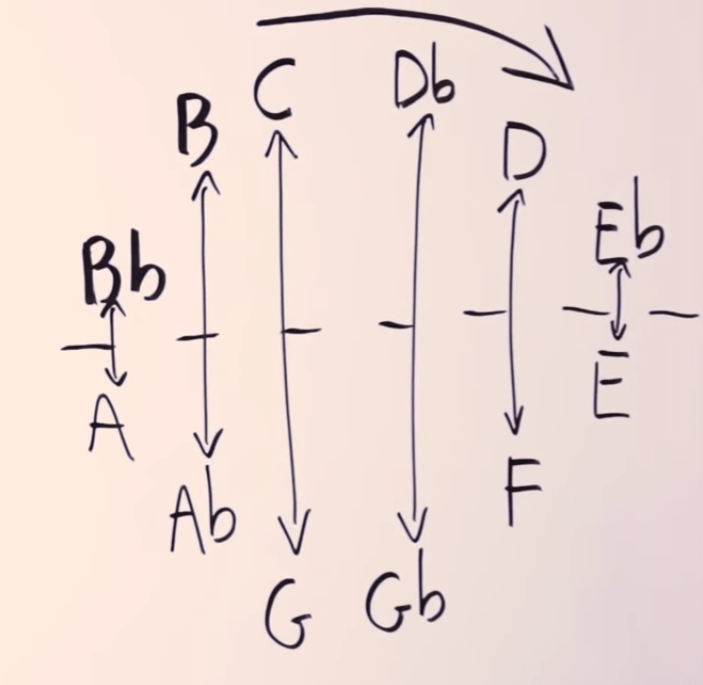
To use this diagram, simply replace all of the notes in a given chord with their counterparts shown in the circle. For example, let’s take the A minor chord from my original chord progression. A minor has A, C, and E. Their negative harmony counterparts are Bb, G, and Eb, which make up an Eb major chord. If we apply negative harmony to the G major chord as well, then we get an F minor chord. Here’s what the progression sounds like now, with the two replacements:
C major – Eb major – F major – F minor – C major
Much more interesting. Another example of a simple chord progression:
C major – D minor – G7 – C major
And now with negative harmony:
C major – Bb major – Dm7/b5 – C major
The reason negative harmony works so well goes back to stable and active notes. The axis that we flip the notes over is in a precise location; all of the stable notes turn into stable notes, and the all of the active notes turn into active notes. If the axis were anywhere else, this would not work.
While negative harmony is an extremely helpful tool, it can also be overused. For example, someone thought it was a good idea to make all of the chords negative in All Star. The result is unsettling, to say the least.
When used in moderation, however, negative harmony can be very effective. After a bit of experimentation, I came up with a short chord progression and melody.
Ultimately, negative harmony is a useful concept that provides alternative chord options when writing music. By keeping the stable and active notes consistent, it allows for logical substitutions that maintain the tension and resolution structure of music.
 Music Theory Blog